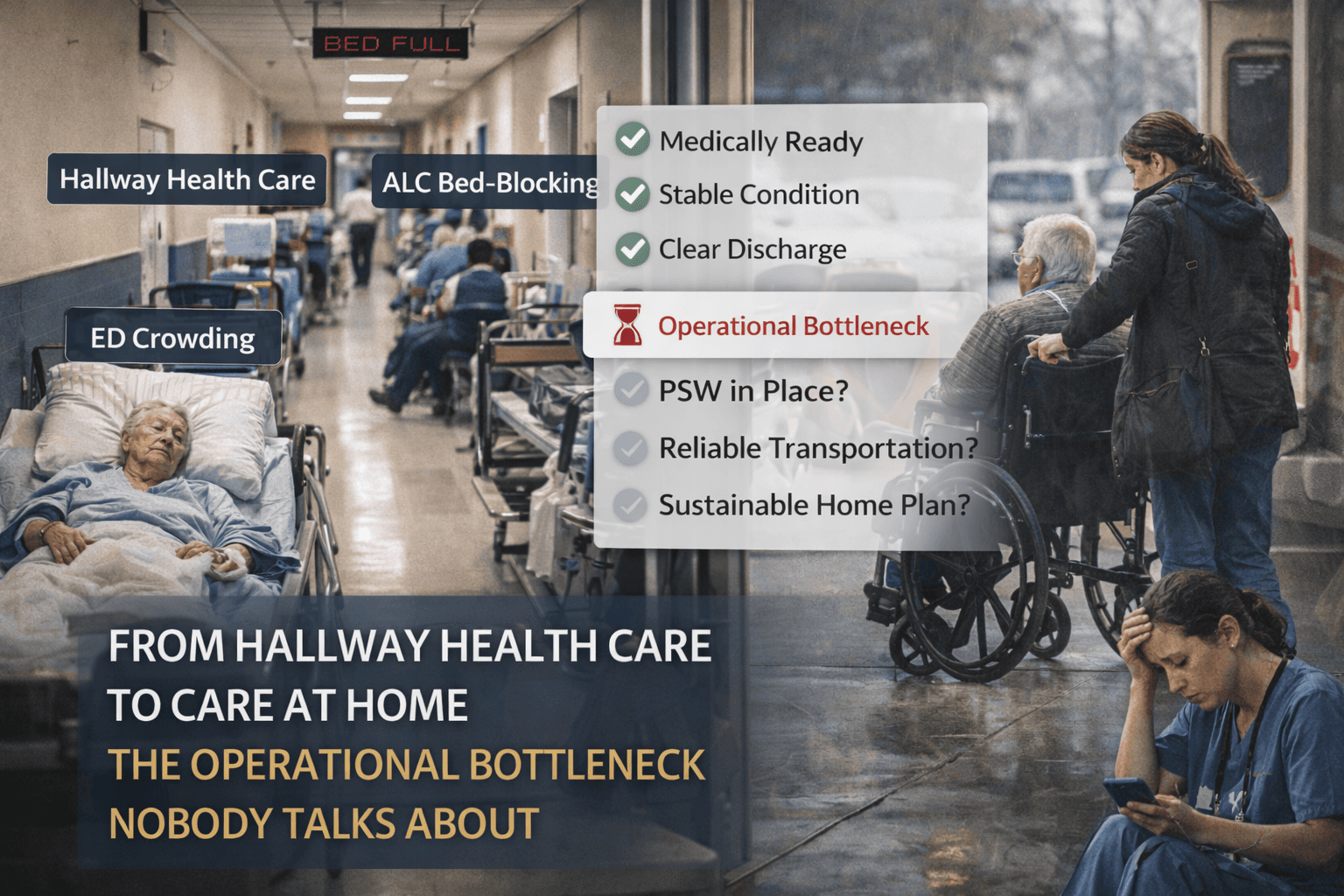
Ontario's "hallway health care" problem is often described as a hospital issue: overcrowded emergency departments, long waits for beds, and staffing shortages.
That is all true. But the operational bottleneck that keeps feeding hallway conditions is frequently outside the hospital: how quickly the system can stand up safe, reliable care at home once a patient no longer needs acute care.
The hallway problem has a name: Alternate Level of Care (ALC)
Alternate Level of Care (ALC) is when a patient is occupying a hospital bed while waiting to receive care somewhere else. Health Quality Ontario notes ALC can harm patients (infection risk, functional decline), families, and the system (reduced access for patients who truly need acute care). (quorum.hqontario.ca)
In plain terms: ALC is bed-blocking caused by delays in moving care to the right place, including home care.
Why ALC drives hallway health care
When ALC grows, it creates a ripple effect:
- inpatient beds stay full
- admitted patients get stuck in the emergency department waiting for beds
- ambulance offload slows down
- ED crowding rises, and "unconventional" care spaces become normal
Ontario Hospital Association materials describe ALC as a long-standing capacity pressure tied to limited access to services outside the hospital, and explicitly link ALC to ED strain, long ED waits, and surgical delays.
They also note that ALC volumes reached a record high in January 2024, and remained consistently higher than previous years afterward.
The discharge gap: "medically ready" does not mean "operationally ready"
Hospitals can decide someone is medically ready for discharge, but the system still has to answer:
- Who will provide the personal support hours?
- How quickly can visits start?
- How will travel time and geography affect reliability?
- What happens if the assigned PSW calls in sick or a client schedule changes?
- Can the plan be sustained for weeks, not just for the first day home?
If those answers are uncertain, discharge slows down, or discharge happens with fragile supports that can fail and boomerang people back to the ED.
A concrete illustration: long waits for home care for ALC patients
In the Auditor General's 2023 report on northern hospitals, ALC patients faced home care wait times ranging from under 30 days to over five years, with average home care waits reported as 34 days (North East) and 161 days (North West) as of March 31, 2023. (auditor.on.ca)
Even if your region is not that extreme, it shows the mechanism: when home care access is delayed, hospital beds stay occupied by patients who should be elsewhere.
Emergency departments feel the downstream impact
The Auditor General's 2023 Emergency Departments audit summary reported 203 temporary emergency department closures between July 2022 and June 2023, involving 23 hospitals, largely due to nursing shortages. (auditor.on.ca)
The same summary explicitly ties long waits and ED crowding to inpatient capacity constraints and "hallway patients" waiting for placement elsewhere in the system. (auditor.on.ca)
This is the connection that matters for home care operations:
If home care cannot start quickly and reliably, the ED cannot clear admitted patients, and the hospital cannot create bed capacity.
The uncomfortable part: home care capacity is not improving relative to the aging wave
Ontario is investing more in health, but capacity relative to need is still tight. A Financial Accountability Office (FAO) presentation on the health sector spending plan notes that for home care, the annual hours of nursing and personal support services per Ontarian aged 65+ are projected to be approximately the same in 2024–25 as in 2019–20. (Ontario Financial Accountability Office)
When the senior population grows quickly and capacity per senior stays flat, the discharge bottleneck becomes structural, not occasional.
The operational bottleneck: allocating scarce home care hours efficiently
Home care delivery is not just a staffing problem. It is also an allocation problem.
Even when total hours exist in the system, they can be trapped behind operational friction:
- inefficient geography and travel time waste
- uneven caseloads that overload some PSWs and underutilize others
- slow territory redesign cycles that let drift accumulate
- manual coordination that cannot keep up with daily volatility
Ontario's hospital efficiency discussion papers point to the core truth: ALC grows when there is insufficient access to services outside the hospital, including home and community care supports.
So if your goal is to reduce hallway health care, one of the most actionable levers is:
make home care capacity easier to deploy, faster to re-balance, and more reliable to sustain.
What "fixing the bottleneck" looks like (practically)
This is not a silver bullet. But it is a high-leverage modernization move.
1) Match discharge demand to real deliverable capacity
Instead of planning from authorized hours, plan from deliverable hours by zone, day, and travel burden.
2) Reduce travel waste with geography-aware caseload design
If you can cut avoidable travel minutes, you effectively create new care minutes without hiring.
3) Balance workload, not just counts
Use a workload metric that reflects reality:
workload = visit minutes + travel minutes + complexity weight + volatility buffer
4) Scenario-plan the next surge
Home care leaders need fast answers to questions like:
- "What happens if we add 10 discharges per week in this catchment?"
- "What if winter travel time doubles in rural areas?"
- "What if we lose 2 PSWs next month?"
5) Make change management defensible
Home Care Ontario's 2024 pre-budget recommendations explicitly include a call to invest in digital modernization, alongside workforce growth and service expansion, as part of relieving pressure on hospitals and long-term care.
Modernization only works if operational decisions are explainable: what changed, who is affected, and why reliability improves.
Metrics worth tracking (if you want to connect home care ops to hallway health care)
- ALC days and ALC rate
- ED "boarding" style measures (patients waiting for inpatient beds)
- time-to-start for home care after discharge (by region) (auditor.on.ca)
- missed care rates and service reliability
- travel time per delivered hour (a proxy for capacity waste)
Closing thought
Hallway health care is not only created inside hospital walls. A big part of it is created in the gap between "ready to discharge" and "able to receive care at home."
Ontario's aging wave makes that gap harder to close. The organizations that can allocate home care capacity faster and more efficiently will not just improve workloads and reliability. They will also help unclog the broader health system.
References
- Office of the Auditor General of Ontario (2023): Emergency Departments – Audit at a Glance (203 temporary ED closures; hallway patients and long waits). (auditor.on.ca)
- Office of the Auditor General of Ontario (2023): Hospitals in Northern Ontario: Delivery of Timely and Patient-Centred Care (ALC dynamics; home care wait times for ALC patients). (auditor.on.ca)
- Ontario Hospital Association (Aug 2024): Ontario Hospitals – Leaders in Efficiency (ALC as capacity pressure; record high ALC volumes; ED ripple effects).
- Financial Accountability Office of Ontario: Ontario Health Sector Spending Plan Review – Presentation (home care hours per Ontarian 65+ roughly same in 2024–25 as 2019–20). (Ontario Financial Accountability Office)
- Health Quality Ontario (Quorum): Alternate level of care (ALC) throughput ratio (definition and impacts of ALC). (quorum.hqontario.ca)
- Home Care Ontario (Jan 2024): Ontario Needs More Home Care – Pre-Budget Recommendations (home care relieves hospital pressure; digital modernization recommendation).