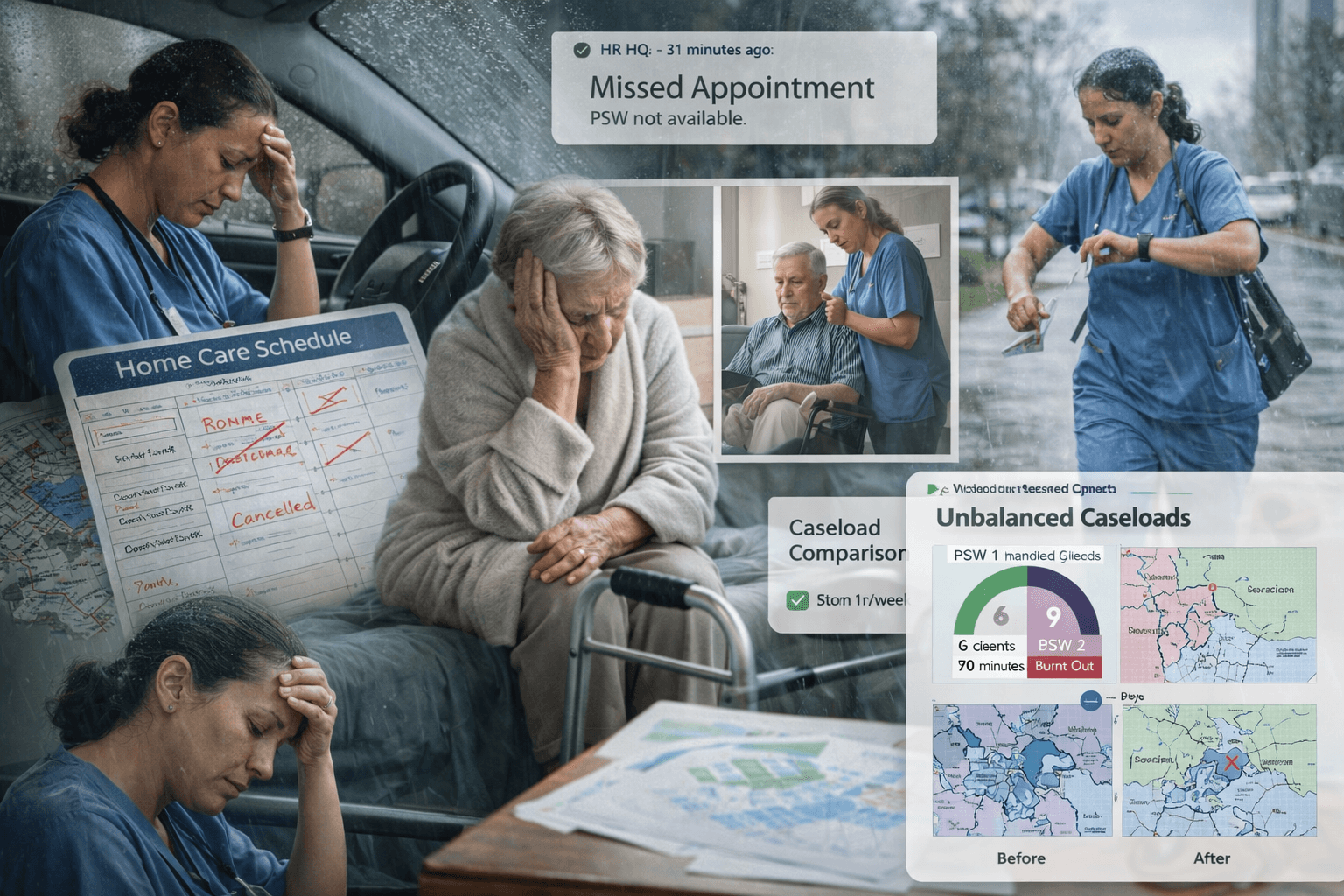
When people talk about Ontario home care, the conversation usually goes straight to staffing shortages. That is real, but it is not the full story.
There's another problem that quietly drives missed care, burnout, and turnover even when budgets increase: caseload imbalance.
Not all workloads are heavy in the same way. In home care, "heavy" can mean too many visits, too much travel, too many high-acuity clients, too many last-minute schedule changes, or all of the above. When those pressures pile up unevenly across teams and territories, you get predictable outcomes: unreliable service delivery, exhausted staff, and families filling gaps.
What caseload imbalance looks like on the ground
A balanced caseload is not "everyone has 20 clients." In practice, balance has to consider:
- Travel burden: a caseload that looks small on paper can be brutal if the geography is spread out.
- Visit intensity: multiple short visits, heavy lifting, or complex personal care has a different load profile than light support.
- Schedule volatility: cancellations, holds, and reassignments create hidden work and stress.
- Coverage fairness: some staff become the "go-to" for hard-to-serve areas and high-need clients.
The result is often a two-speed system: some PSWs are overloaded and burning out, while others have dead time caused by routing inefficiency, cancellations, or inconsistent allocation.
Missed care is a symptom, and the numbers show it
Ontario tracks "missed care" rates. One Home Care Ontario appendix reports that the provincial missed care rate for Personal Support services fell to 0.48% in March 2023, but still remained far above the stated target of 0.054%. (Home Care Ontario)
It also shows large regional variation, including wide differences between areas and outliers well above target. (Home Care Ontario)
More recently, Ontario Health atHome's Service Accountability Agreement (effective 2024) lists missed care rates as a performance indicator, with a "current corridor" of 0.05%–0.1% (by service type). (ontariohealthathome.ca)
Even if your local missed care rate looks "small," it is worth saying plainly: every missed visit is a patient who did not receive planned support.
And missed care is only the part we can easily count. It does not fully capture shortened visits, "bare minimum" care when schedules run late, or the informal backfilling done by unpaid caregivers.
Burnout is not a personal failing, it is an operating condition
When the workload is chronically uneven and unpredictable, burnout stops being an individual issue and becomes a system output.
A 2025 report summarized by CSA Group reported:
- 63% of PSWs have left or seriously considered leaving their jobs in the past two years
- 72% experienced burnout monthly or more often
- 68% reported regular anxiety and stress (CSA Group)
If you are trying to stabilize home care capacity, this is the hard truth: caseload imbalance is a retention problem.
When the hardest caseloads remain hardest month after month, the system gradually selects for churn.
Why imbalance happens (even with good leadership)
Imbalance is not caused by one bad decision. It is caused by drift.
Small changes accumulate:
- new housing developments and shifting population density
- changing client mix (higher acuity, more complex needs)
- staffing changes and vacancies
- seasonal patterns (winter travel, summer scheduling, flu season)
- policy and eligibility shifts
Over time, a territory map that was "good enough" becomes misaligned with reality. If rebalancing only happens once in a while, you are always responding late.
Volatility is also baked into the work. In a peer-reviewed Ontario study analyzing home care personal support service volumes during COVID waves, the authors noted a high level of "authorized services not delivered," driven primarily by client-initiated holds and cancellations (99.3% of the service volume reduction), while provider missed care accounted for a much smaller share during that period. (PMC)
The specific pandemic context matters, but the operational lesson carries forward: home care delivery is inherently dynamic. A static plan degrades quickly.
The operational bottleneck: manual caseload design
Most organizations still rely on a manual process for territory and caseload design:
- spreadsheet balancing
- institutional knowledge
- exceptions handled by phone calls
- rebalancing triggered only when things become painful
That approach struggles because home care caseloading is a districting problem with real constraints:
- caseloads must be contiguous or at least coherent geographically
- workloads must be balanced across multiple dimensions
- travel time must be kept realistic
- program rules and "do not split" boundaries must be respected
- changes must be explainable to staff and stakeholders
When that is done manually, it becomes slow, political, and difficult to repeat.
What to do instead: treat balancing as an ongoing operational function
If Ontario's senior population continues to grow, the system will need more staff. Even "maintaining the status quo" requires significant hiring. One Home Care Ontario research summary states that from 2024 to 2029, Ontario's home care sector would need an additional 6,800 PSWs just to maintain current service levels.
But alongside hiring, the sector needs a second lever: reduce operational waste and prevent chronic overload.
That means making caseload balancing:
Measurable Define a balancing metric that reflects reality, not just client counts. For example:
workload = (visit minutes) + (travel minutes) + (complexity weight) + (volatility buffer)Continuous Track imbalance monthly. Do not wait for an annual redraw.
Scenario-driven Be able to test "what if" questions quickly: staffing changes, growth areas, winter routing, new program needs.
Defensible Produce clear before-and-after outputs: what moved, why it moved, and how fairness and reliability improved.
A practical checklist for leaders
If you run a home care operation and want to reduce missed visits and burnout, start here:
- Track three metrics together: workload balance, travel burden, and missed care rate. (Home Care Ontario)
- Detect drift early: identify which territories are trending worse month-over-month.
- Rebalance more often with smaller changes: it is easier on staff and easier to explain.
- Make the rationale transparent: fairness improves when people can see the "why."
References
- Home Care Ontario (June 2024): Maintaining Stability and Growing Personal Support Capacity in Ontario's Home Care System (with appendices), including missed care rates and targets. (Home Care Ontario)
- Ontario Health (effective 2024): Ontario Health – Ontario Health atHome Service Accountability Agreement, including performance indicators for missed care and timeliness. (ontariohealthathome.ca)
- CSA Group (June 2025): summary reporting PSW burnout and intent-to-leave metrics. (CSA Group)
- King et al. (2023): peer-reviewed analysis of Ontario home care personal support service volumes and disruptions (holds, cancellations, missed care) during COVID waves. (PMC)
- Home Care Ontario / Newswire (Feb 2024): demographic surge and PSW hiring needs to maintain service levels.