"Modernizing home care" gets used a lot in Ontario. It shows up in strategy documents, funding announcements, and transformation plans.
But on the ground, modernization is not a slogan. It is whether the system can reliably deliver care, protect frontline staff from chronic overload, and make decisions that are fair, repeatable, and explainable.
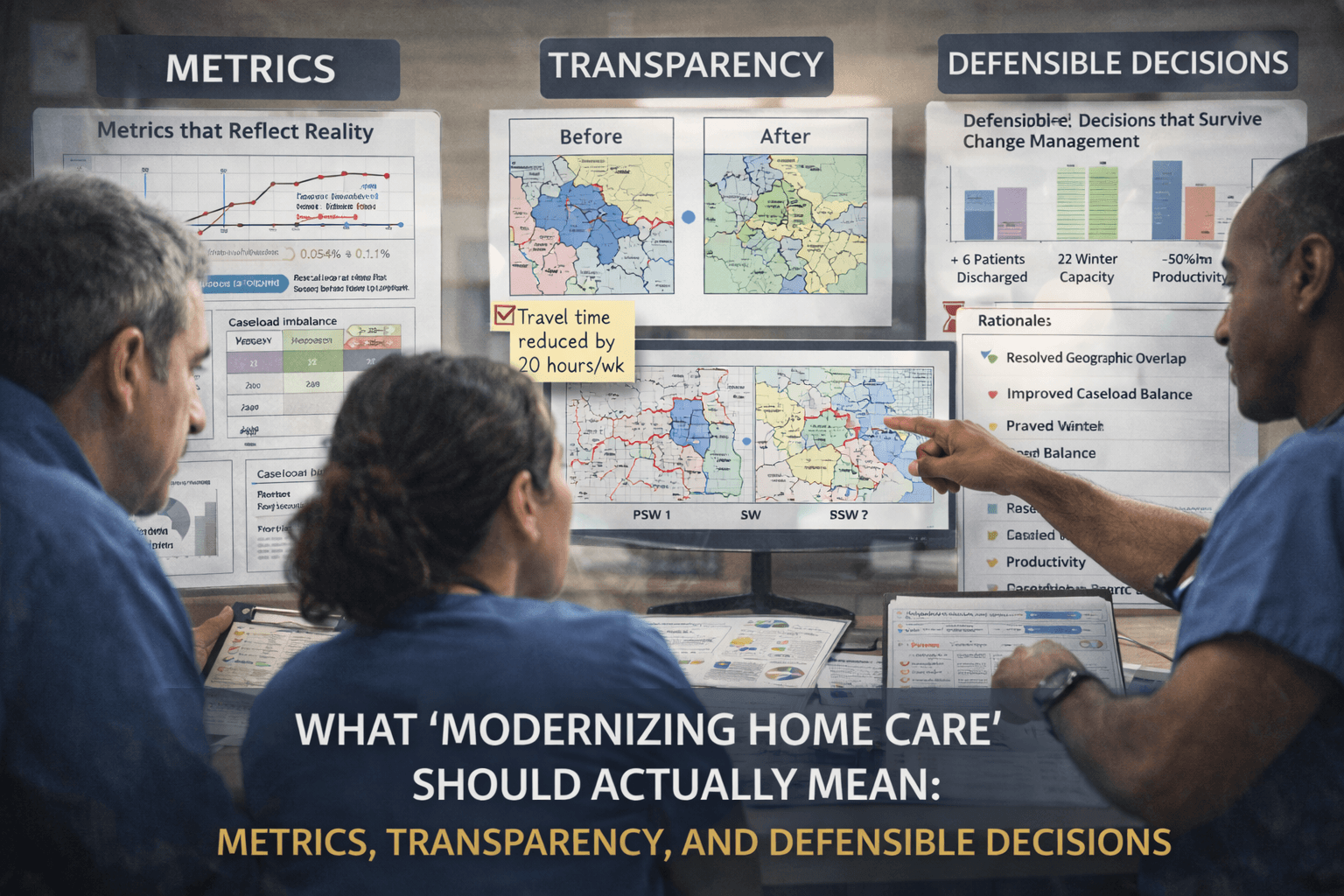
If we want home care to scale with an aging population, modernization should mean three practical things:
- Metrics that reflect reality
- Transparency that builds trust
- Defensible decisions that survive change management
Modernization starts with defining what "good" looks like
Most home care systems can tell you volumes: number of clients, number of visits, total hours.
Modern systems can also tell you:
- where the system is imbalanced
- where it is wasting capacity
- where reliability is breaking down
- what would change under different scenarios
In other words: modernization is decision quality, not just digitization.
The core problem: home care is dynamic, but planning is often static
Home care delivery shifts daily:
- new referrals and discharges
- client complexity changes
- cancellations and holds
- staff availability changes
- seasonal travel realities (especially winter)
Yet territory and caseload design is often done as a static, manual exercise.
That mismatch guarantees drift, and drift guarantees crisis-driven redesign.
The metrics that actually matter (and why)
1) Missed care and reliability
Ontario tracks "missed care" and related service delivery performance. Home Care Ontario's appendix reports a provincial missed care rate for Personal Support services of 0.48% (March 2023) versus a target of 0.054%.
Ontario Health atHome's accountability materials also define missed care as a core performance measure, with a corridor in the low tenths of a percent.
A modern system should be able to answer:
- Where is missed care clustering geographically?
- Is it driven by staffing gaps, travel burden, or unrealistic workload assumptions?
- Which caseloads are most fragile under schedule volatility?
2) Workload balance (not just counts)
Client counts are a weak proxy for workload.
A useful workload metric should include:
- visit minutes
- travel minutes
- complexity weights
- volatility buffer (expected disruption)
This is the heart of fairness. Two caseloads can have the same number of clients and feel completely different.
3) Travel burden and capacity waste
Travel time is not just an inconvenience. It is a capacity drain.
When travel minutes climb, the same workforce delivers fewer care minutes, and stress rises. Modernization should include travel as a first-class operational metric, not an afterthought.
4) Drift over time
The most overlooked metric is drift, measured as how fast the system moves away from "balanced" after a redesign.
Modern organizations treat drift like technical debt:
- it is inevitable
- it compounds
- you manage it with smaller, more frequent corrections
5) Discharge readiness throughput
If home care is meant to reduce hospital pressure, you need operational metrics tied to throughput:
- time-to-start after discharge
- reliability in the first 7–14 days post-discharge
- whether plans remain stable, or collapse into reassignments
This connects home care ops to ALC and hallway conditions.
Transparency: modernization requires trust, not just tools
Most territory and caseload changes fail for one reason:
people don't trust the rationale.
Frontline staff feel the impact immediately. Managers take heat from both sides. Clients and families worry about continuity. If the system cannot clearly explain decisions, the safest path becomes "do nothing," even when the status quo is unfair.
Transparency in a modern home care environment should include:
- Before/after maps that show what moved
- Workload deltas by caseload and by geography
- Impact summaries that quantify how many clients, staff, and visits are affected
- Reason codes that explain why a boundary moved (travel reduction, workload equalization, new referral density, etc.)
- Audit trails showing who ran scenarios, what constraints were applied, and what was approved
That is how you convert a "political redraw" into a defensible operational change.
Defensible decisions: prove the trade-offs, don't argue them
The hardest part of home care planning is that it is multi-objective:
- minimize missed visits
- keep caseloads fair
- limit travel
- respect boundaries
- maintain continuity
- handle staffing constraints
- adapt to demand surges
You cannot optimize everything at once, so you need to make trade-offs explicit.
Defensible decisions means:
- you can show which goals you prioritized
- you can show how much improvement you achieved
- you can show what you chose not to optimize and why
This is the difference between "we think this is better" and "we can demonstrate this is better."
What Ontario modernization language suggests (and what it implies operationally)
Ontario has repeatedly stated intentions to modernize home and community care through better integration and connected care. For example, Ontario's connected care plan includes commitments to modernize home care through Ontario Health Teams and connected delivery models.
But integration alone does not solve allocation. Even in a connected system, you still have to decide:
- how to draw territories
- how to balance caseloads
- how to deploy scarce PSW capacity
Modernization needs an operational layer that can run those decisions repeatedly, quickly, and transparently.
A simple modernization maturity model (practical, not academic)
Level 1: Manual and reactive
- spreadsheet-based balancing
- rebalancing only during crises
- limited ability to explain decisions
Level 2: Digitized but still manual
- digital scheduling tools exist
- territory redesign still slow and infrequent
- limited scenario capability
Level 3: Measured and repeatable
- standard workload metrics
- drift monitoring
- quarterly rebalances
- clear before/after reporting
Level 4: Scenario-driven and transparent
- constraint-aware optimization
- "what-if" planning
- explainable outputs and audit trail
- change management built into the workflow
Ontario's aging wave pushes organizations toward Level 3 and 4 whether they want it or not.
Practical takeaways for leaders
If you want to make modernization real in the next 90 days:
- Define a workload metric beyond client counts
- Start tracking drift monthly
- Pair missed care rates with travel burden by geography
- Build a repeatable rebalancing cadence (smaller, more frequent changes)
- Require every redesign to generate an impact summary and rationale
That is modernization: not just more money, but better decisions and better delivery reliability.
References
- Home Care Ontario (June 2024): Maintaining Stability and Growing Personal Support Capacity in Ontario's Home Care System (with appendices), including missed care rates and targets.
- Ontario Health atHome: service accountability/performance materials including missed care as a key indicator.
- Government of Ontario (2023): Your Health: A Plan for Connected and Convenient Care (home care modernization and connected care through Ontario Health Teams).